



Ateneo Teacher On A Mission To Bring Back Phl History In High School
As the country celebrates National History Month this August, one teacher is fighting historical revisionism by working to restore Philippine history in the high school Araling Panlipunan curriculum.
In 2015, when the historical biopic Heneral Luna was shown in theaters nationwide, actor Epy Quizon, who plays Apolinario Mabini in the film, was approached by a group of students who have seen the film.
They asked why his character never stood up throughout the film’s duration.
Quizon was dismayed by the question. Apparently, today’s students aren’t aware that Mabini was paralyzed from the waist down due to polio, hence his moniker The Sublime Paralytic.
“That is sad… what have we been teaching our kids in our history classes?” Quizon said in a Facebook post.
The incident went viral on social media, getting the attention even of former president Benigno Aquino III. “Ang komento pa raw ng ilang netizen ay baka daw pagod lang si Mabini noong mga panahong iyon. Napailing po talaga tayo nang maikuwento ito sa akin,” Aquino said in his speech at the 28th Apolinario Mabini Awards.
Moved from high school to elementary
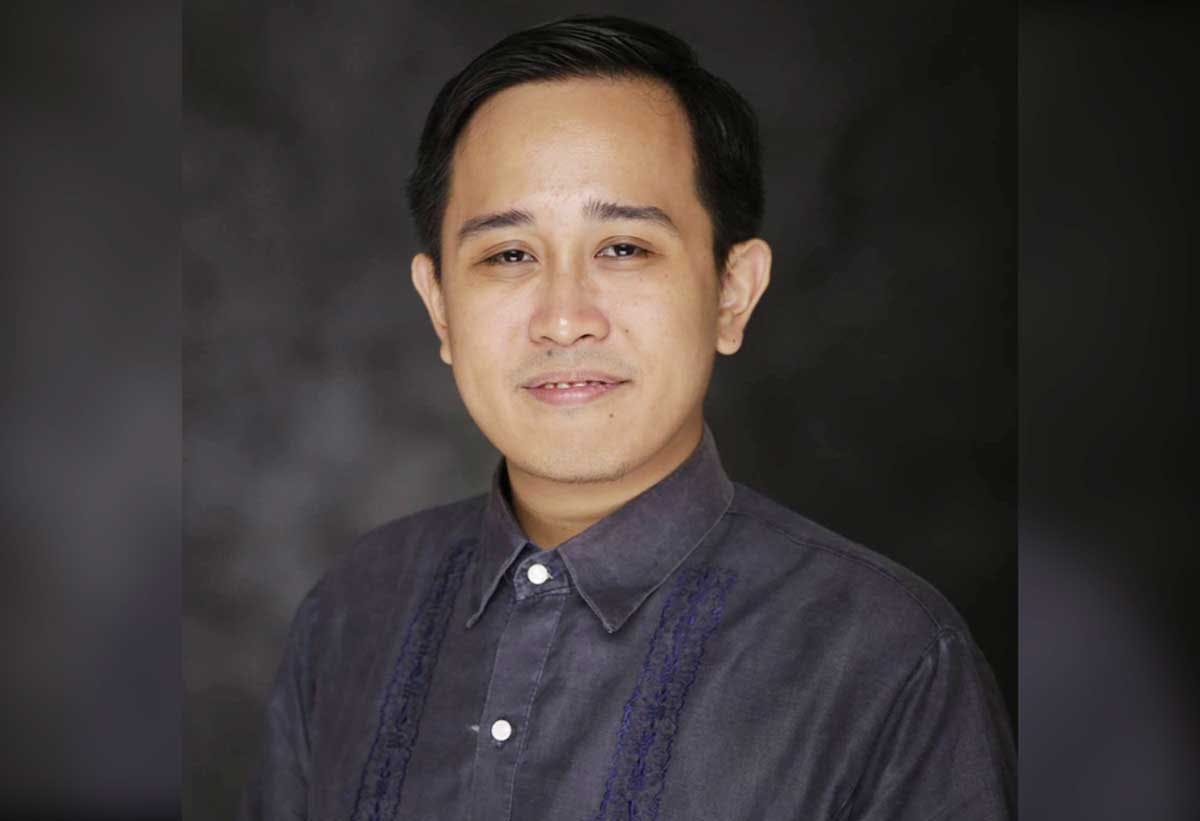
AB History graduate and Araling Panlipunan teacher Jamaico Ignacio, who at the time was teaching at Malayan High School of Science in Pandacan, Manila, also heard similar comments about the film from his students, which gravely concerned him. And it was not just the students’ lack of knowledge about Mabini that alarmed him.
“As a private school teacher, I noticed a weakening of appreciation for national history. Kung mahina na nga dati, mas humina pa ngayon. The confluence of social media, online streaming and other technological distractions is not necessarily helping,” Ignacio, who now teaches at the Ateneo de Manila Junior High School, said.
At the time, the Department of Education (DepEd) had released Order No. 20, s. 2014, which assigned a new nomenclature in the learning areas for teaching Araling Panlipunan from Grades 7 to 12.
Under the new nomenclature, Philippine history will no longer be taught to Grade 7 students. Instead, the learning area was transferred to Grades 5 and 6. Beginning 2014, Grade 7 and 8 students would have Asian Studies in their Araling Panlipunan classes, while Grade 9 and fourth year high school students would have World History and Economics, respectively.
By school year 2017 to 2018, the nomenclature became Asian Studies for Grade 7, World History in Grade 8, Economics in Grade 9 and Contemporary Issues in Grade 10. Grade 11 and 12 students, meanwhile, were allowed to choose elective courses that would tackle local, national, regional and global issues.
The new nomenclature for the Araling Panlipunan curriculum was based on the theme created by the US National Council for Social Studies, which is based on the “Expanding Environment Approach” to teaching Social Studies — from learning about one’s self and others, learning about the family and the community, learning about one’s province and region, understanding one’s nation, to learning about the outside world.
Prone to historical amnesia
With the implementation of Order No. 20 beginning 2014, Ignacio saw how his students’ knowledge of Philippine history and issues had progressively declined. Told about Mabini, students said they would just Google the topic.
“Since then, I noticed na pawala ng pawala ang interes para sa kasaysayan ng Pilipinas. Kung dati magtatanong ka sa isang high school student, at least may magsasabi na may familiar kay Mabini, mali-mali nga lang siguro ang babanggitin nilang info. Ngayon, halos wala nang nakakaalala kay Mabini. Igoo-Google na lang daw nila,” Ignacio said.
Ignacio believes it’s wrong for the DepEd to put Philippine history in elementary, which focuses on basic information and lower-order thinking skills. This is in contrast with Philippine history in high school that focuses on higher-order thinking skills.
Under the Bloom’s Taxonomy, which is a hierarchy of different learning objectives and skills that educators should set for their students, lower-order thinking skills are those that involve remembering, understanding and applying, while higher-order thinking skills are analyzing, evaluating and creating.
“Elementary age learning should be reinforced in adolescent age and young adult age learning. Kung walang reinforcement, hihina at hihina ang pagkatuto. Developmental psychology proves this. Kaya nga maganda dati may Philippine History at all educational levels, from elementary to college,” Ignacio stated.
With this declining interest and appreciation for Philippine history, Ignacio fears the impact it would have on students. He said that without a dedicated course for Philippine history in high school, it leaves the floodgates open for impressionable high school students to acquire historical information online — whether valid, invalid, or purposely half-valid. He said it would be more difficult for them to critically discern without a course to at least give them a chance to properly reflect.
“Other than being prone to historical amnesia, students tend to be prone to historical revisionism. They tend to believe whatever comes up on their Facebook feed. Lalo na kung miseducated or, worse, gawa ng politically driven or malicious partisan forces ‘yung mga mahahabang posts, maniniwala sila kaagad. One purpose of Philippine history in high school is to give our students an opportunity to critically discern historical information,” Ignacio said.
Ignacio also believes that the ongoing historical revisionism is made worse by the removal of a dedicated Philippine history in high school. He said that concerned Araling Panlipunan teachers are having a hard time dealing with adolescent students who firmly believe certain information that are invalid or half-valid.
Bringing the advocacy online
Fearing the impact that the policy would have on students, Ignacio decided to advocate for the restoration of Philippine history in the high school Araling Panlipunan curriculum.
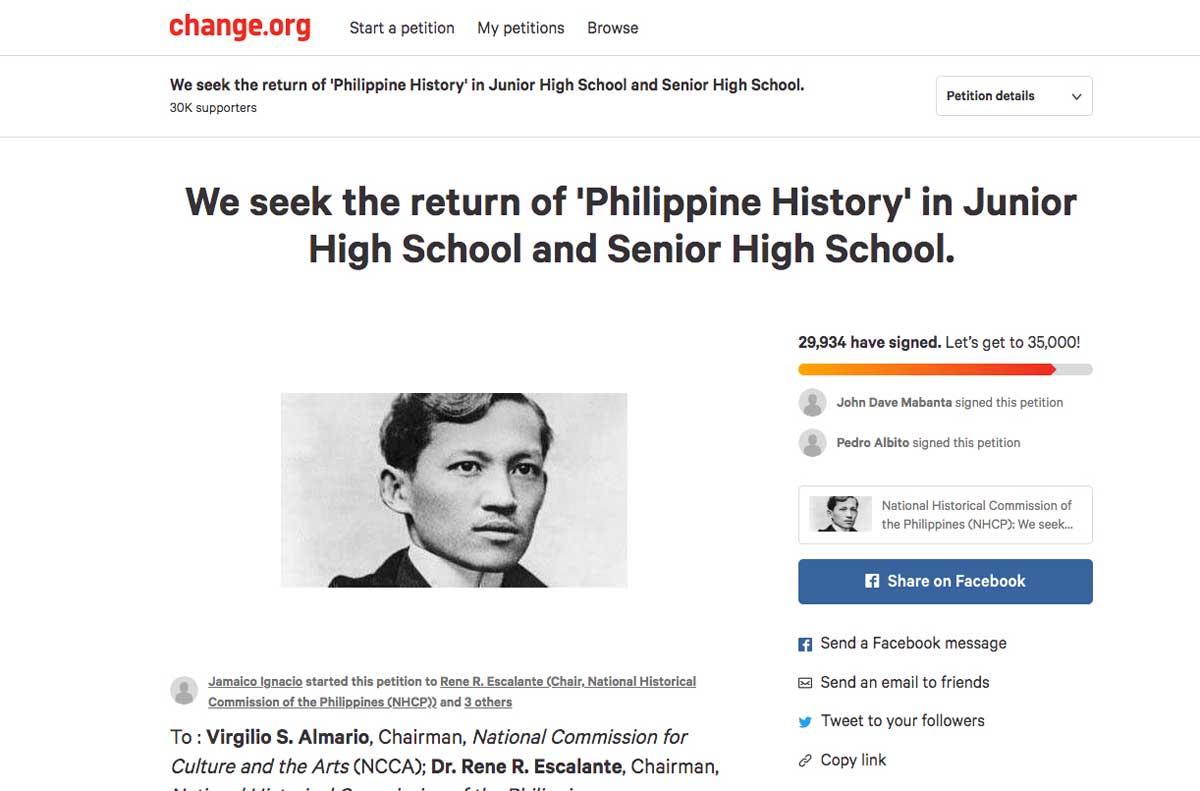
In 2018, he started an online petition in Change.org, which calls on the DepEd, the National Historial Commission of the Philippines (NHCP), the National Commission for Culture and the Arts (NCCA) and then Senate committee on education, arts and culture chairman Francis Escudero to review Order No. 20, s. 2014. Escudero is now Sorsogon governor.
The petition also calls on the NHCP and NCCA to hold a national dialogue on the question of having Philippine history in secondary education.
Aside from calling for a policy review, Ignacio also proposed his own nomenclature for teaching Araling Panlipunan, which he hopes the DepEd could look into. In his nomenclature, Philippine history in elementary would be decongested so that it would focus only on the pre-colonial to Spanish period in Grade 5 and the American period to World War II in Grade 6. For the Post-War and Contemporary Philippine History, he proposes discussion of the subject along with global issues in Grade 10.
In Grade 12, Ignacio proposes a “Philippine Diplomatic History with ASEAN and China” as a core research and survey subject for one semester so that students can explore the country’s diplomatic history in relation to its neighbors and contemporary international issues.
So far, the petition has garnered 29,940 signatures, particularly from teachers and students alike. To further bolster the advocacy, Ignacio created a Facebook page and group to disseminate information on the petition and provide interested parties with updates. Likewise, he has appeared in television interviews for his advocacy.
“You’d be surprised by the number of people sharing our posts and memes. Thousands of people are still interested in Philippine history. Hindi lang nila alam na tinanggal ito sa high school level. So we seek to share posts and info about this for the meantime. Fortunately, thousands of people are willing to share the info via social networking,” Ignacio said.
As for the DepEd, Ignacio said it has been cool to the petition even after more than a year of it being online. “I don’t expect a response anymore from them,” Ignacio said.
He added, “Hopefully in the future, our main target is to have our side heard in the basic education committees in the House of Representatives and in the Senate alongside DepEd. Let the legislators hear our side — that’s our long-term target.”