ADB Pushes For Face-To-Face Classes For Economic Growth
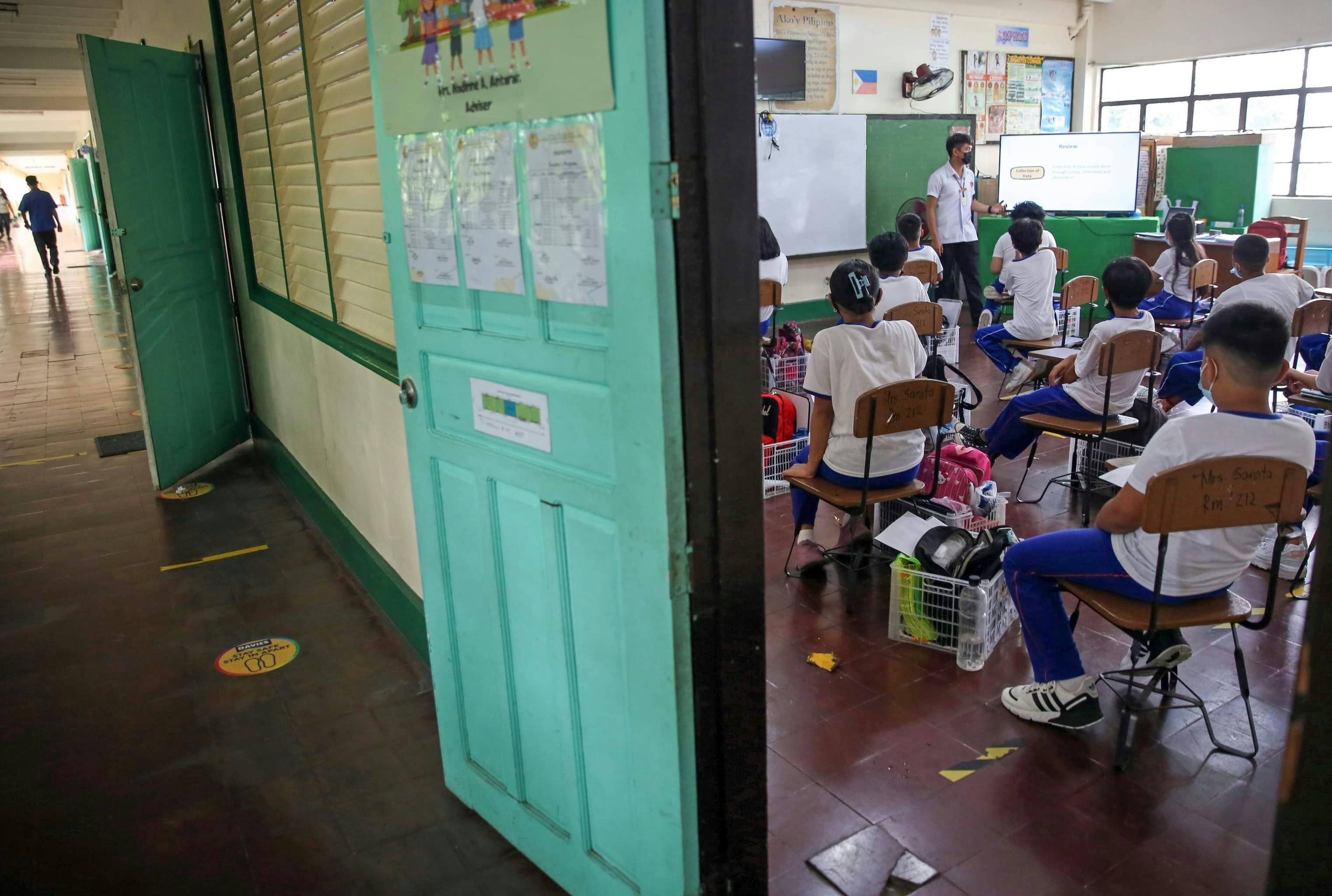
At present, just a little over 70 percent of public elementary and high schools in the country have returned to face-to-face learning, while the number is significantly smaller among private learning institutions.
The Philippines should immediately address the scarring effects of school closures due to the pandemic so as not to face decline in its overall economic growth in the years ahead.
In its recent blog, the Manila-based Asian Development Bank (ADB) said extensive impacts of prolonged closure of learning institutions are being felt in the whole of Asia.
ADB economist Cyn-Young Park said that immediate actions are needed to mitigate further damage.
“Earning losses from school closures, which reduce labor productivity, will lead gross domestic product to fall in almost all countries,” Park said.
“But economies with significant populations of school children and college-going youth in rural areas and in the poorest and second wealth quintiles will be worst-hit,” she said.
The Philippines had one of the longest school closures in the world due to the pandemic. While some schools have been reopened, the country has been significantly late in the game.
The National Economic and Development Authority (NEDA) has long been calling for the full resumption of face-to-face classes as the education sector remains to be the missing piece in the country’s economic recovery.
It is estimated that around P11 trillion in productivity losses will be incurred due to prolonged school closures.
“If a country has a high share of unskilled workers, learning and earning losses will be also more significant. This is because the impacted children would be less likely to transition to higher education and more likely to instead enter the unskilled labor force,” Park said.
She maintained that school closures will likely leave long-term economic scarring effects, both in terms of earnings losses for individuals and the reduction in long-term productivity and growth for economies.
“Without appropriate policy support, disruptions in school education will translate into fewer students transitioning to higher education, higher unemployment and reduced earnings potential,” she said.
Last week, the Department of Education (DepEd) called on all public and private schools to resume face-to-face classes for the incoming school year in August.
At present, just a little over 70 percent of public schools have returned to face-to-face learning, while the number is significantly smaller among private learning institutions.
To address long-term scars on both students and the economy, Park said the government must support learning recovery by conducting assessments of learning losses among the impacted school-age population.
She noted the importance of figuring out learning gaps to ensure that effective learning programs will be devised.
She added that there is a need to invest in education and skills, especially those from poor, rural and socially disadvantaged groups, and embrace digital transformation in education.
Long-term plan
On Friday, June 3, the DepEd launched its first long-term plan for basic education in a bid to improve delivery and quality of education in the country.
The Basic Education Development Plan 2030 will serve as the strategic roadmap covering both formal and non-formal education to address access gaps while building resilience in the education sector.
The BEDP 2030 will also help address the impacts of the pandemic on learning, participation and education delivery.
Education Secretary Leonor Briones said the roadmap is designed to address the root causes of problems on quality of education, and sustain and enhance relevant programs in the education system while also introducing innovations to embed the rights of children and youth in learning.
“BEDP is part of the administration’s efforts to ensure that the call for improving the access to and quality of basic education will continue as these are the challenges that were identified by various researches. BEDP 2030 was anchored on the Sulong EduKalidad framework to harmonize the strategies within DepEd,” Briones said.
The BEDP 2030 will serve as a blueprint for the department for the next decade in formulating, implementing, coordinating, monitoring, evaluating and supervising policies, plans, pro-grams and projects.
Briones said this roadmap aimed at helping learners become globally competitive will be turned over to the next administration.
Internet access
Looking forward, incoming Department of Information and Communications Technology (DICT) secretary Ivan John Uy said president-elect Ferdinand Marcos Jr. would be prioritizing internet access in far-flung areas.
“We were instructed to look at how we can extend digital connectivity to remote areas to give access to our countrymen, especially in areas that are not reached by the internet now,” Uy said in a televised public briefing.
“The Philippines is an archipelago and there are so many islands that have no access to the worldwide web, and we must prioritize this. So, that’s one of the marching orders (of Marcos),” he said.
The president-elect also wants to improve “e-governance” in order to simplify access to services and reduce corruption in government, said Uy. As Marcos had promised improving digital infrastructure during the campaign, Uy said technology is one of the crucial factors to improve revenue generation.
“So, we are looking at streamlining, reducing red tape and minimizing queues at various government offices,” he said, noting that some individuals would need to be absent in their job just to process documents, including certifications and clearances.
Automating government transactions would minimize human intervention, thus reducing corruption in government, he added.
Uy also welcomed the National Telecommunications Commission (NTC)’s approval of Elon Musk’s Starlink to provide satellite internet services in the Philippines.
“This is a welcome development because we will have an additional player now. It’s a satellite provider. So, the internet will reach especially the remote areas. We are working out the de-tails,” he said.
“Hopefully, the satellite receivers arrive soon so these can be deployed in different areas of the country, which are not reached by traditional telcos,” he added. – With Romina Cabrera, Helen Flores