



Why Did The Philippines Refuse To Back UN Resolution On Gaza?
The resolution already condemned “all acts of violence against Palestinian and Israeli civilians, including all acts of terror and indiscriminate attacks,” but the Philippines said it wants something more.
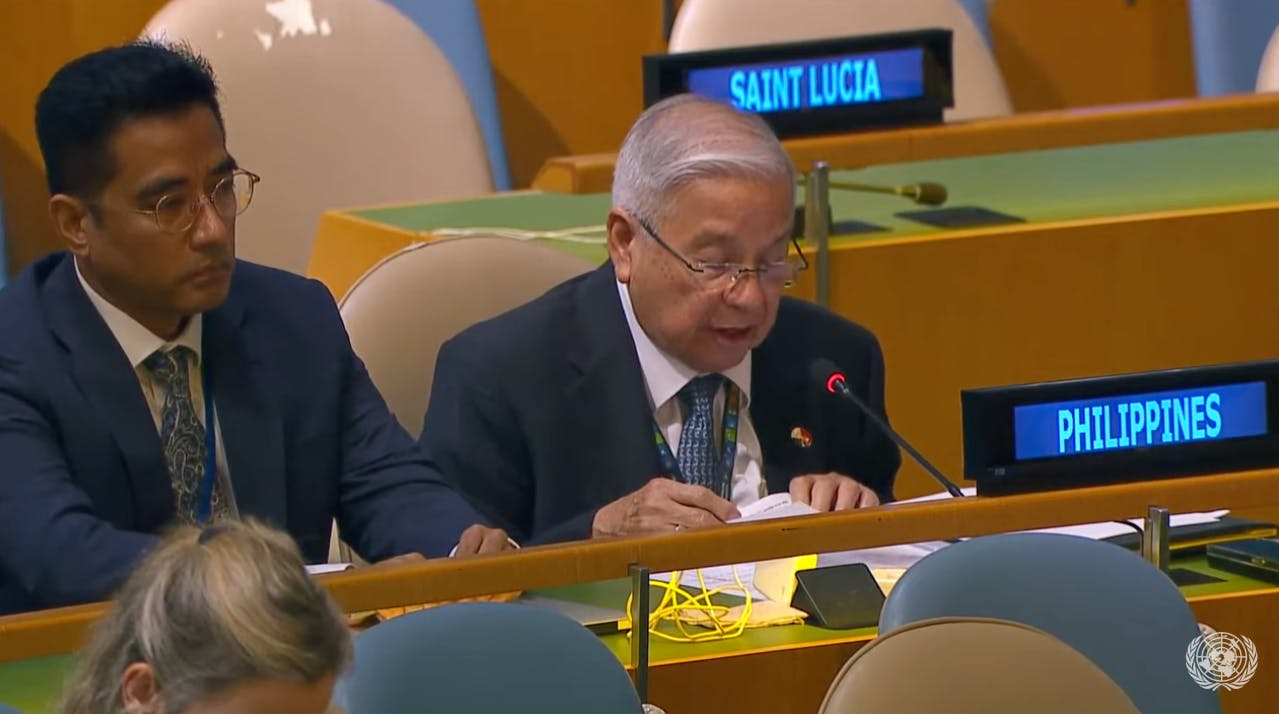
The United Nations General Assembly (UNGA) on Friday, Oct. 27, overwhelming adopted a non-binding resolution calling for a humanitarian truce in Gaza. But the Philippines was not among those that voted in favor of the resolution.
Instead, along with 43 other countries, the Philippines opted to abstain from voting on the resolution.
The reason? The lack of an explicit condemnation of the cross border attacks launched by Hamas militants on Israel on Oct. 7.
Crisis In Gaza: UN Calls For ‘Humanitarian Truce’; Philippine Abstains From Vote
During the UNGA’s emergency session held at the UN headquarters in New York, Philippine Ambassador and Permanent Representative to the UN Antonio Lagdameo said that the resolution includes many elements that the Philippines support, such as the condemnation of all acts of violence against both Israeli and Palestinian civilians.
He also noted that the resolution reaffirms the Philippines’ long-standing support “for a two-State solution with a safe and independent Palestine and a secure Israel living in peace.”
“Overall, it expresses the grave concern of the international community over the situation, which the Philippines genuinely shares. We condole with all victims and their families and pray for a peaceful resolution of this conflict,” said the ambassador.
“However, as we would condemn all terrorist attacks, the resolution does not mention nor condemn the terrorist attack of 7 October by Hamas leading to the deaths of innocent civilians, including women and children, as well as some Filipinos,” he added.
The ambassador also reiterated the Philippine recognition of Israel’s right to self-defense as provided under the UN Charter.
“Therefore, despite commendable efforts of the co-sponsors to improve the original text, for these reasons, my delegation abstained on the resolution,” he said.
The resolution, which called for the "immediate, durable and sustained humanitarian truce leading to a cessation of hostilities,” passed after receiving 120 affirmative votes, 14 negative votes and 45 abstentions.
Citing technical issues, Iraq later changed its vote from abstain to yes, making the final tally 121 yes, 14 no and 44 abstain.
Israel and its closest ally, the United States, were among those that voted against resolution, which was proposed by Jordan on behalf Arab states.
Meanwhile, among those that abstained from the vote was Canada, which pushed for an amendment that will include a condemnation of the Hamas attacks. It failed to get enough votes to be in the final text of the resolution.
Many of those that supported the amendment abstained from the vote, including the United Kingdom, Germany, Australia, Japan, South Korea and Ukraine.
But some Western countries – notably France, Spain, New Zealand, Portugal and Switzerland – ended up supporting the resolution even without the amendment.
Most Southeast Asian nations also voted in favor of the resolution, except the Philippines, which abstained, and Cambodia, which has no recorded vote in the final tally.
Solidary with global community
In Manila, the Department of Foreign Affairs (DFA) said Canada’s proposal “sought to achieve more balance” and incorporate a critical element in an important UN resolution.
The proposed amendment wanted to identify the Hamas, unlike the original draft that made no mention of both the militant group and Israel.
“We continue to support efforts of the UN, particularly the UN Security Council, the UN humanitarian system and the global community, to decisively address this crisis and put a stop to the alarming deaths and suffering in Gaza and Israel,” the DFA said.
It stressed that the Philippines has issued several statements on the developments in Israel and Gaza, which it said is “in solidarity with the global community in calling for swift action to address the scale of human suffering that is affecting populations on both sides.”
In his speech, Lagdameo maintained that the Philippines supports the efforts of the UN to deliver urgent humanitarian assistance and essential supplies to Palestinian civilians caught in the conflict.
The country also urged the UN Security Council to endorse and support coordinated efforts with UN entities for the safe evacuation and protection of migrants in conflict zones.
“We earnestly appeal to all parties involved to cooperate in safeguarding their security. With approximately 30,000 Filipino nationals in Israel and a further 130 in Gaza, their safety and well-being remain paramount to us,” said Lagdameo.
“Reaffirming our position, the Philippines firmly supports a two-state solution, consistently aligned with past international agreements and relevant UN resolutions. Both Israelis and Palestinians deserve a future where their rights, aspirations, and security are recognized and upheld,” he added.
‘Utterly shameful’
Renato Reyes Jr., president of Bagong Alyansang Makabayan, described the Philippine government’s abstention as “utterly shameful.”
“Neutrality in the time of genocide is unacceptable. We cannot as a country remain silent to the unfolding catastrophe. Shame on the Philippine government. No regard for human rights at home, no regard for human rights abroad,” he said in a post on X.
“Yes, the Philippine abstention is a ‘vote’ for the continued genocide in Gaza. There is no other way to describe it,” he added.
Reyes questioned why the government made it a “pre-requisite” to mention that Hamas attacks for it to support a resolution opposing the killing of Palestinian civilians.
“So the Philippines' condemnation of genocide is conditional, not a matter of principle? The condemnation of genocide depends on the mention of October 7? It does not follow. This is echoing the Zionist line and serves the Zionist agenda,” he added.


