#SONA2020 Duterte Slams Lopezes, Drilon; Will The Gov’t Get ABS-CBN Frequencies For Distance Learning?
What did Senate Minority Leader Franklin Drilon say that made President Duterte fume? According to Drilon, oligarchy can only be dismantled once the country gets rid of political dynasties. Duterte has built a political clan in Davao City.

President Duterte wants television frequencies that have been reverted to the government to be used for distance learning as he reiterated that he would not allow face-to-face classes while coronavirus disease 2019 (COVID-19) infection risks remain.
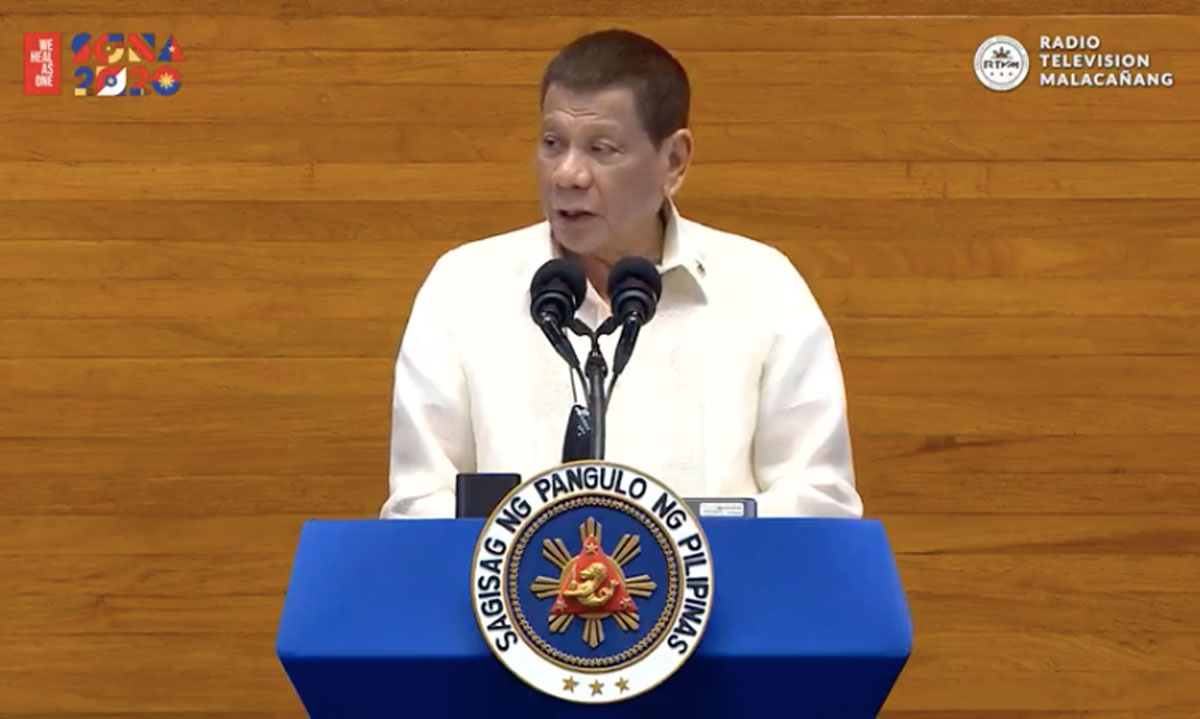
In his fifth State of the Nation Address on Monday, July 27, Duterte said he has ordered the Department of Justice, the Department of Science and Technology and the Department of Information and Communications Technology (DICT) to craft a program to ensure that the frequencies are used by the government through the facilities of People’s Television 4 “for the utmost benefit of the Filipino people.”
Without a vaccine for COVID-19, Duterte declared, “I will not allow the traditional face-to-face teaching or learning unless the risk of exposure for the sickness are eliminated. I cannot and will not put to risk the health and lives of our students and teachers.”
“TV frequencies reverted back to government for whatever cause or reason shall not be used exclusively to the exclusion of other persons or other dummies to cope with the demand of the next normal. This will be used to provide uninterrupted quality education to our children in our shift to e-learning,” he said.
Duterte did not provide details, but he made the remark days after Deputy House Speaker Luis Villafuerte Jr. filed House Resolution No. 1044 recommending the temporary use by the government of ABS-CBN Corp.’s television and radio frequencies for distance learning.
ABS-CBN, which has been accused by Duterte of maligning him during the 2016 elections, was denied a franchise by the House legislative franchises committee on July 10, a move seen as an attack on press freedom.
Duterte said the government plans to increase the number of schools with information and communication technology equipment in the coming months. The Department of Education (DepEd) and DICT are building up the public education network that will connect all public schools and education offices nationwide, he added.
“We will prioritize the connection of all last-mile schools and those with no electricity supply and have it via satellite, and energized via solar panels,” he announced.
Last-mile schools, according to DepEd, are those with fewer than four classrooms, usually makeshift and nonstandard ones; no electricity; no funds for repairs or new construction projects in the last four years; and a travel distance of more than one hour away from the center, accessible only through difficult terrain.
“By 2022, before I step down, the PENS (Partnership of Employees and Non-Teaching Staff) shall be realized. I’m referring to the program. I will, I will do it,” the President said.
Duterte clarified that he allowed the conduct of face-to-face classes in low-risk areas, but this would start only in January 2021.
“Because my thinking is that by September we would have the vaccine. How to get it, from the producers or from other governments, is really something which we have to deal because everyone, it’s a global need. And everyone will go for it,” he said.
“Life that is lost is life that is lost forever. Courses that are not substantial can be supplemented; education that is delayed can be recovered. We must implement online learning, modular learning, and TV and radio-based broadcast, which students coming from different backgrounds can avail (themselves of). DepEd will provide the printed modules for those who cannot afford online learning,” he added.
Drilon, Lopezes get presidential lashing
In the beginning and end of the SONA, Duterte slammed Senate Minority Leader Franklin Drilon for supposedly defending the Lopezes being the owners of ABS-CBN.
The President called the Lopezes oligarchs whom Drilon supposedly sided with after ABS-CBN’s application for renewal of franchise was junked by the House committee on legislative franchises for alleged violations.
Duterte blasted “opportunists” for taking advantage of the situation while the government is busy handling the COVID-19 crisis in the last four months.
“My countrymen, it is sad that while government focuses its attention and resources to battle the coronavirus, there are those who take advantage of a preoccupied government,” he said.
“One of them is Sen. Frank Drilon. In an interview, he arrogantly mentioned among others that oligarchs need not be rich,” the President said. “Then he linked the anti-dynasty system with oligarchy and the topic was my daughter and son. This happened after the committee on (legislative franchises) voted 70-11 to deny the grant of franchise to ABS-CBN. Obviously, he was defending the Lopezes, that they are not oligarchs.”
Duterte, who has been criticized for stomping on press freedom over the ABS-CBN franchise issue, talked about how the rich elite controlled the country through the biased mass media.
“Great wealth enables economic elites and corporations to influence public policy to their advantage,” he said.
While Palace officials have been claiming that the Chief Executive did not have any direct hand in the act of Congress, Duterte also admitted he did not get fair treatment from ABS-CBN during the 2016 polls.
“Media is a powerful tool in the hands of oligarchs like the Lopezes who used their media outlets in their battles with political figures. I am a casualty of the Lopezes during the 2016 election,” Duterte stated.
Drilon, a member of the opposition, said he was defending freedom of the press, not the Lopezes.
“The closure of the ABS-CBN sent a chilling effect. As I said before, for democracy to thrive we need free press and to allow journalists to exercise complete freedom to do their mandate of reporting facts without fear,” Drilon noted in a statement.
In the face of a pandemic, Drilon stressed that the country needs more access to information. He said he aired his support for the renewal of ABS-CBN’s franchise because “undeniably the network complements other stations in providing timely and accurate reportage even in the farthest locality unreachable to others, even to the government.”
“I was defending the (more than) 11,000 people and their families who would lose jobs amid the pandemic, not the Lopezes,” Drilon said.
Duterte chided Drilon for saying that oligarchs need not be rich and that political dynasties should be dismantled first.
In an online forum on July 15, Drilon said “we must review the whole structure” as this “may in fact or make oligarchy easy to achieve.”
“The lack of an anti-dynasty system or provision in our system allows oligarchy to continue,” Drilon underscored in the forum. “(Political dynasties) wield power for their own benefit. It has gone so bad that these dynasties now hold simultaneous national and local positions.”
Drilon defined oligarchy as a form of power structure in which power rests with a small number of people who use it to seek personal gain or to benefit their business interests.
He said oligarchs influence “the decision of the government” or use their political power and wealth to ensure that state policies will protect their interests.
The minority leader made the pronouncement after the President boasted in a speech in Sulu that he had successfully dismantled the oligarchy in the country without declaring martial law.
According to Drilon, the President has the “capacity” to push for the passage of an anti-dynasty law in a Congress dominated by his allies.
“As part of the political reform to prevent oligarchy, maybe we should look at our political party system because that is not helpful. Our present system cannot be cited as anathema or a check on oligarchs,” Drilon said.
This did not sit well with Duterte, whose daughter Sara Duterte-Carpio serves as Davao City mayor while her brother Sebastian is the vice mayor. Duterte’s eldest son Paolo is the congressional representative of Davao City’s 1st District.
Drilon had expressed belief that the President could “rise above” the situation if he really wanted to “remove oligarchy as a power structure.”
In supporting the dismantling of oligarchy, Drilon also warned that cronies could take over if necessary reforms are not put in place.
“What is it in our legal system that makes oligarchy possible? To me, we must study that. Structural reform is necessary,” he said.
After assailing Drilon for supposedly defending ABS-CBN, Duterte further lambasted him for his supposed role in drafting the concessionaire contract for the Ayala-owned Manila Water, the sole provider of water services to over six million people in the east zone of Metro Manila.
“You know Drilon, I’d like to ask Drilon: were you a part of ACCRA (Law Offices) when this contract of Ayala water was being drafted? Why are you fulminating? Bakit ikaw lang ang galit, nasabi mo na dynasty?” Duterte asked.
Duterte branded the minority leader as a “hypocrite” for urging the President to push for the passage of the anti-dynasty bill. Duterte said this was the task of Congress.
“You know you cannot pass an anti-dynasty law. You are there in Congress, take the lead,” he said.
“The oligarchy that exists in this country is the same that dates (back to) the Spanish time,” Duterte said, adding that oligarchs are those who control the Philippines by getting into the businesses of “water and electricity.”
“That’s your oligarchy, Drilon,” Duterte pointed out.
Duterte also lashed out at the minority leader supposedly for the “billions and billions” collected by the water concessionaire without building any treatment facility.
“You do not protect the oligarchs here. You are the only one. I suspect you were the one who helped when you were with ACCRA,” Duterte, himself a lawyer, said. “Ayala got ACCRA, and ACCRA did it.”
Toward the end of his speech, Duterte then apologized to the audience as he conceded that his SONA was not the proper forum for his gripes, but added that the Filipino people “need to know” and “to get the facts.”
“Hinawakan ninyo ang mga tubig at mga kumpanya, that’s oligarchy,” the 75-year-old leader said. “The best of lines, whatever, the government gets it before whoever.”
In an interview with radio station dzMM, Drilon clarified that he had retired and had no participation in ACCRA’s rendering of legal services to Manila Water. He said he had not even read the contract that Duterte was complaining about.
“Taong 1990 po wala na ako sa ACCRA Law. Ako po ay nag-retire na noon. Kahit anino ng kontrata na iyan, hindi ko nakita (I was gone from ACCRA Law in 1990. I had retired then. I have not seen even the shadow of that contract),” Drilon said.
On telcos: ‘I might just as well close all of you’
In his SONA, Duterte also pointedly addressed Smart Communications, Inc., and Globe Telecom, Inc., and gave them a deadline to “kindly improve your services before December” because “I want to call Jesus Christ to Bethlehem.”
“I’ll be strict. Itong Smart, pati Globe, ilang taon na ito? At ang sagot palagi sa akin, ‘the party cannot be reached.’ Eh, saan napunta ‘yung yawa na ‘yun (This Smart, as well as Globe, how many years have they been here? The answer to me is always, ‘the party cannot be reached.’ Then, where did that devil go)?” Duterte exclaimed.
“If it is just the question of added capitalization or infusion of money, go and look for it. Maghanap kayo (Look for it) because if you are not ready to improve… I might just as well close all of you and revert back to the line telephone, at kukunin ko ‘yan at expropriate ko sa gobyerno (and I will get it and expropriate it in favor of the government),” he said. “Sometimes, government is pictured to be weak and incompetent because we cannot really force our mandate.”
He did not address the delayed efforts of the Dito Telecommunity Corporation – a consortium by Duterte’s top campaign financier Dennis Uy and the Chinese government-owned China Telecommunications Corporation – to become the country’s third telco industry player. – With Vince Nonato