



Economic Saviors No More: OFW Deployment Dips; 95,000 Seek To Go Home
The resiliency of migrant Filipinos will not work in the current situation since workers all over the world are boxed in by lockdowns due to the coronavirus disease 2019 pandemic, academicians wrote.
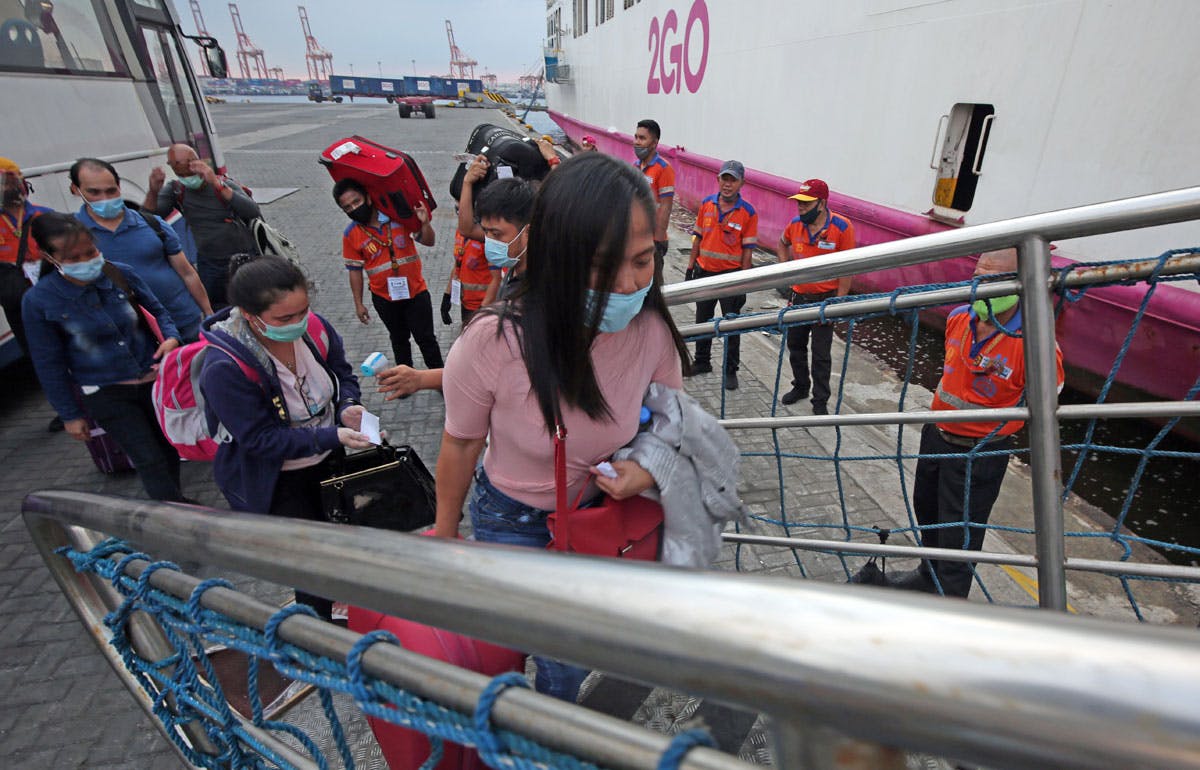
There are now 343,551 overseas Filipino workers affected by the coronavirus disease 2019 (COVID-19) pandemic, but Labor Secretary Silvestre Bello III announced on Tuesday, June 2, that so far, only 95,000 OFWs have expressed their intent to return to the country.
Out of these 95,000 stranded OFWs, Bello said 42,000 were supposed to be repatriated, but only 16,679 were able to secure permits and could go home.
“That makes our work lighter, because we are left with only 95,000 stranded; only 42,000 to be repatriated. We can only repatriate 16,000,” he said.
As this developed, the Philippines’ overseas employment also suffered a significant slump in the first quarter of the year as COVID-19 began spreading to countries employing Filipino workers.
Philippine Overseas Employment Administration (POEA) chief Bernard Olalia said hiring of Filipino workers dropped sharply in April of this year compared to the same period in 2019.
“Month to month comparison showed (a) 99 percent drop, but the aggregate deployment from January to April 2019 decreased only by an average of 39 percent,” Olalia explained.
Massive displacement
During a press briefing at Malacañang, Bello said the 95,000 OFWs were stranded overseas either due to travel bans or lack of flights to take them home.
Bello admitted he was surprised that almost 200,000 of the 343,551 OFWs affected by the pandemic do not want to return to the Philippines and would rather stay abroad, especially those who are in the United States and Europe.
He said the 343,551 OFWs displaced were either terminated from work or could not return to their jobs because of the lockdowns.
“These workers are under no work, no pay category and thus affected by COVID,” Bello explained.
There are 2,390 OFWs who have been infected with COVID-19 so far, with 72 deaths.
“We reported two weeks ago that we are expecting 42,000 OFWs to be repatriated from May to June. But only 16,679 have the required exit visas and plane tickets for them to come home,” Bello said.
Bello sees this as a welcome development since the government’s quarantine facilities will not be overwhelmed. “So, only 16,679 will be coming in, and some have come in already,” he said.
Decline in deployment
Regarding the massive decline in deployment, Bello cited travel restrictions imposed in many OFW destination countries as the primary reason.
However, he is optimistic that the hiring of Filipinos abroad will see some improvement as other countries have begun easing lockdowns.
“Actually, we still have thousands of job orders, but we’re unable to deploy because of the restrictions. Those job orders have not been cancelled and are still effective,” Olalia noted.
He said the POEA would assess the health situation nationwide and in other countries to determine whether the ban on deployment of healthcare workers abroad could be lifted.
The Inter-Agency Task Force (IATF) for the Management of Emerging Infectious Diseases has imposed a temporary ban on deployment of healthcare workers overseas amid the declaration of a national health emergency in the country.
Olalia says the government must be sure that Filipino healthcare workers will not be put at risk before the country allows the resumption of deployment.
“If we can see that they are no longer in harm’s way, there is a possibility to revisit the policy and make proper recommendation to the IATF,” Olalia noted.
Except for healthcare workers, other categories of OFWs are not prevented from working overseas. Under existing guidelines, however, OFWs are required to execute, prior to departure, a declaration of their awareness of the risks posed by COVID-19 in their destinations.
At the onset of the pandemic, the POEA projected a 50 percent drop in deployment of OFWs if other countries, particularly those in the Middle East would not halt the entry of foreign workers in a bid to stop the spread of COVID.
Last week, the Department of Labor and Employment (DOLE) projected that a million OFWs could lose their jobs as a result of the pandemic.
Olalia clarified that the one million projection was based on the number of OFWs who were affected by the pandemic and have sought financial assistance from the government.
“The figure has to be validated because not all those who sought cash assistance were permanently displaced. Many of them were just temporarily affected and could return to their work when the lockdown in their destination countries eases,” he said. “We will wait for further developments abroad and will see.”
The government estimates the number of OFWs at 10 million, accounting for a tenth of the country’s population. About 120,000 of them work on cruise ships around the world, and their jobs could be at risk as COVID-19 cripples the sector.

Saviors no more
In light of the current developments, academicians are urging the government to look at other sectors that can help the economy stay afloat given the impact of COVID-19 on OFWs.
In a policy paper titled “Overseas Remittances: Saving the ‘Resilient’ Owners of this Philippine Lifeline,” professors Jeremaiah Opiniano and Alvin Ang wrote that the pandemic would not spare OFWs.
“Hence, resiliency that overseas migrants developed in the past will not work in the current situation since workers in every part of the world are boxed in by lockdowns,” Opiniano and Ang said in their paper.
Opiniano is an assistant journalism professor at the University of Santo Tomas and executive director of the Institute for Migration and Development Issues. Ang is director of the Ateneo Center for Economic Research and Development and an economics professor at the Ateneo de Manila University.
“In addition, repatriation seems to be an expensive proposition for OFWs. They are required to go on quarantine upon arriving home for a minimum of 14 days until after their test results are released,” they said.
Ang and Opiniano said with the combined impacts of the global economic stoppage, lockdowns and declining oil prices, base-to-worst case scenarios could lead to a big decline in cash remittances.
Due to the global crisis, cash remittances are seen to decline from $30 billion in 2019 to $27 billion (base case) or down to $24 billion (worst case).
OFWs remitted about $30.13 billion in 2019, higher than the $28.94 billion in 2018.
Read more: Phl May Lose Up To $10 Billion In OFW Remittances Amid COVID-19 Pandemic
“The observation that overseas migrants can be resilient and can still send money during crisis situations may not hold water at this moment,” Opiniano and Ang noted. “Both migrants and their families back home are affected by these crises simultaneously.”
In their policy report, Ang and Opiniano cautioned the government against relying too much on remittances from Filipinos overseas – both workers and immigrants – to “save” the Philippine economy just like in previous crises.
Workers that have been laid off and repatriated are those in the tourism, leisure, travel, retail and basic services sectors, the two professors said, adding that most OFWs today belong to these sectors rather than the higher paying professionals such as those in the health sector.
“These affected migrant workers will most likely face the same unemployment prospects back home since similar sectors were affected by lockdowns,” they pointed out.
Economic disruptions
In an earlier paper, Ang and Opiniano said there could be some 300,000 to 400,000 OFWs who would face job losses, fewer workdays, pay cuts, lower incomes and repatriations this year.
“These are a result of the ongoing pandemic, of fluctuations of global oil prices, and of expected national and global recessions,” they noted.
Over a 45-year period, the policy paper noted that there were six occasions of lesser remittances from OFWs year-on-year. The sharpest decline was in 2000 when $744 million less than in the previous year was sent in. This year’s projected remittances may be the steepest in Philippine migration history, year-on-year.
“The Philippines needs these remittances more than ever. They have proven to be an added boost to the positive Philippine economic story the past decade, and have helped the country elude negative impacts of financial crises,” they said.
“However, as this crisis is not a financial, but a real economy crisis, putting too much expectations unto remittances – to ‘save the day’ once again – may put undue pressure unto our modern-day ‘heroes,’ ” the policy brief noted.
Financial challenges
Nonetheless, overseas Filipinos and their families try to save, independent of the economic situation. In fact, the share of those saving above P100,000 a month has increased from 22 percent in 2009 to 38 percent in 2018 based on reports from the Philippine Statistics Authority.
Ang and Opiniano said Filipino migrant workers and their families would most likely rely on themselves and apply their financial knowledge to cope with the pandemic challenges.
A majority of them learned about money and finance by themselves, but there are many who did not judiciously keep track of their incomes and expenses, the paper read. Hence, they may inevitably make wrong financial decisions, providing additional unnecessary stress.
Faced with the pressure to provide remittances to their families back home and the threat of job losses and repatriation, there would be OFWs who would be forced to take “unnecessary risks” to sustain the support they give their families back home, the paper said.
“The concern is that OFWs may not have much excess amounts left in the short-to-medium term; the same is possibly true with their families,” Ang and Opiniano said in their paper. “The situation may force those overseas Filipinos outside of the health sector to unnecessarily risk themselves to mitigate the challenges of their families back home.”


