



READ: Marcos’ Speech At The 77th United Nations General Assembly
Here’s the full text of President Marcos’ statement during the 77th Session of the United Nations General Assembly (UNGA) General Debate in New York on Sept. 20, 2022.
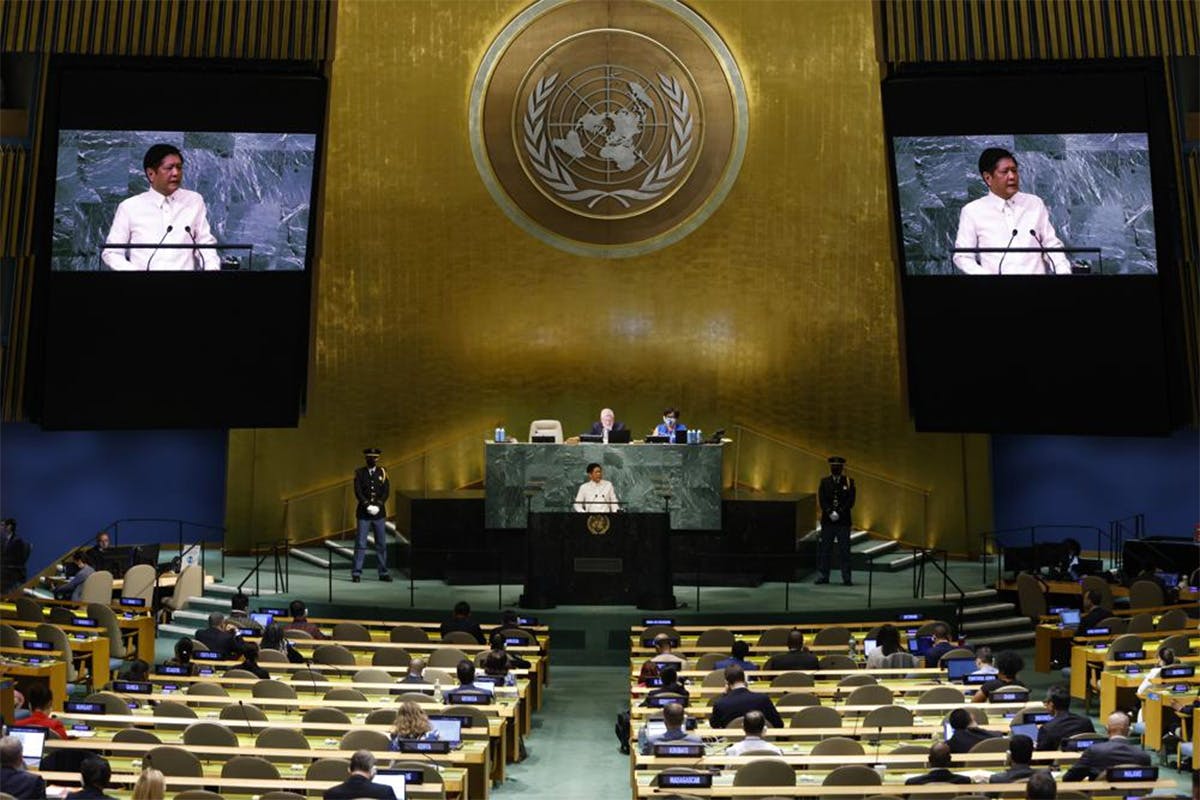
Mr. President, Excellencies. I am Ferdinand Marcos (Jr.) and I am the President of the Republic of the Philippines. I stand today on behalf of 110 million Filipinos.
At this time of crisis and opportunity, I bring with me the spirit of their enduring commitment to the ideals of our United Nations. This commitment is reflective in our solid contributions to the cause of peace and of justice. By shepherding the Manila Declaration of 1982, we help affirm that differences should only be resolved through peaceful means.
By reinforcing the predictability and stability of international law, particularly the 1982 United Nations Convention on the Law of the Sea, we provided an example of how state should resolve their differences – through reason and through right.
These two contributions provide useful guidance for our time, for amidst challenging global tides, an important ballast stabilizes our common vessel. That is our open, inclusive, and rules based international order that is governed by international law and informed by the principles of equity and of justice.
As I have underscored, the Philippines shall continue to be a friend to all and an enemy of none. This world order traces its roots to 77 years ago, your first Asian predecessor, Mr. President, General Carlos P. Romulo, called on our leaders then to make this floor our last battlefield. To determine in this hall whether humanity is to survive or be wiped out in another Holocaust. Our peoples chose survival. They chose cooperation, they chose peace. And by doing so, they make history.
Today, history once again calls to us to make these choices. We are confronted by tectonic shifts that will inform the end and flow of this coming century. Of these I see four challenges to the continued survival of our global community.
First is climate change.
The time for talk about if and when has long since past. It is here. It is now. Climate change is the greatest threat affecting our nations and our peoples. There is no other problem so global in nature that it requires a united effort one led by the United Nations. The effects of climate change are uneven and reflect an historical injustice. Those who are least responsible suffer the most. The Philippines for example, is a net-carbon sink. We absorb more carbon dioxide than we emit and yet, we are the fourth most vulnerable country to the effects of climate change. This injustice must be corrected. And those who need to do more must act now. We accept our share of responsibility and will continue to do our part to avert this collective disaster.
We call on industrialized countries to immediately fulfill their obligations and to the United Nations Framework Convention on Climate Change and the Paris Agreement to cut their greenhouse emissions, provide climate financing, and technology transfer for adaptation for the most vulnerable and developing countries. To lead by example. We look forward to concrete outcomes at the Conference of Parties in Egypt later this year.
When…future generations look back, let them not ask why we did not take this opportunity to turn the tide? Why did we continue in our profligate ways until it was too late? This threat knows no borders, no social class, nor any geopolitical consideration. How we address it will be the true test of our time.
Second: the development of advanced technologies is rapidly transforming human life and experience. We still barely understand how these transformations are unfolding and where they are leading. The imminent diffusion of these emerging technologies could solve many of our old problems, but they could also disrupt our political and social orders. Our governance structure must keep up.
Third: widening geopolitical polarities and sharpening strategic competitions are transforming the international political landscape. A profound lack of trust is putting enormous strains on our multilateral system. Our very charter is being violated around the world as we speak. In Asia, our hard-won peace and stability is under threat by increasing strategic and ideological tensions. These behoove us to uphold the ideals that led to the establishment of this parliament of nations. And to reject any attempt to deny or redefine our common understanding of these principles.
Even as we grapple with these new long-term shifts, we remain beset by an unresolved problem: inequalities and inequities within and among countries continue to persist. And they continue to demand urgent action.
Therein lies our fourth transcendent challenge: this injustice was evident during the pandemic where the richer nations immediately receive vaccines at the expense of the have-nots. We see for example the dangers of this lurking in the persistent digital divide and in ballooning debt burdens. As we awaken from the economic stupor caused by the pandemic, we must reinvigorate the world economy. We must use public and private resources to encourage the expansion of trade, investment, and technology transfers to accelerate development. Knowledge and intellectual gains must flow freely to allow those lagging behind to catch up. Sustainable development will be hampered to the detriment of all. If existing structures in the global economy remain unreformed.
Mr. President, in these past three decades, Filipinos have achieved significant strides on our path to sustainable development. Despite the challenges of the pandemic or the global economic upheavals, we remain on track to reach upper-middle income status by next year.
With steady investment in food, public health, education, and other social services, we expect to become a moderately prosperous country by 2040.
I am confident that we will achieve this vision.
Yet, no nation stands alone. The achievement of our national ambition requires a global environment that creates conditions that allow all nations including ours to thrive in peace. We need the United Nations to continue to work. And we, the Philippines, are determined to be part of that solutions.
The Philippines did not hesitate to donate to the COVAX Facility that help provide vaccines in many parts of the developing world, multilateralism and international cooperation due make a difference.
Filipino health workers were at the frontlines in many countries to curb the spread of the virus risking and oftentimes sacrificing their own lives to save those of others. We have always been an optimistic and courageous nation despite the enormity of these challenges, we believe that solutions are within our collective grasp. You, Mr. President, have already identified three tools at our disposal.
First: solidarity.
We need to re-affirm the wisdom of the founders of our united nations. This means transcending our differences and committing to ending war, upholding justice, respecting human rights, and maintaining international peace and security.
Nuclear weapons continue to pose an existential threat despite our efforts to build norms that resoundingly prohibit them. We must reject the notion of deterrence and remain committed to decreasing the global stockpile of these weapons. At the same time, we must also address the scourge of the proliferation of all weapons, be they small arms, light weapons, or IEDs. Our work must also focus on ensuring that the international system remains fair not only for all states but more importantly for all peoples. This system must work for the most vulnerable, especially the marginalized, migrants, refugees. The world has witnessed the enduring contribution of migrants in the fight against this pandemic. We still dream of an end to the disturbing incidents of racism, of Asian hate, of all prejudice. The Philippines' United Nations Joint Program on Human Rights is an example of a constructive approach that puts our people, not our politics, at the center of this work.
It provides a model for revitalizing the structures that facilitates solidarity between the UN and the sovereign duty-bearer. Our continued solidarity will also benefit from a reformed and more inclusive security council. And empowered General Assembly that can hold the council to account.
At the same time, the UN must forge ahead with its flagship tradition of global peacekeeping. My country's experience in building peace and forging new paths of cooperation can enrich the work of the security council and to this end, I appeal for the valuable support of all UN member-states for the Philippines' candidature to the security council for the term of 2027 to 2028.
Our success in the Bangsamoro Autonomous Region in Muslim Mindanao in the south of the Philippines is a centerpiece of these efforts. The peace that we have forged after many decades of conflict among warring factions and clans demonstrates that unity is possible even in the most trying circumstances. Inclusive dialogue involving all stakeholders including women, the youth, faith leaders, and civil society conducted w/ patience and good faith has produced a credible and solid foundation for self-government that paves the way for lasting peace and sustainable development.
We take the same approach in Asia. The Philippines builds partnerships for peace and development through dialogue including through interfaith and inter-religious dialogue esp. through ASEAN.
In the face of great diversity, we believe that partnerships formed the bridge to unite all of us in promoting peace and stability in the Asia-Pacific region. Our global community is only as strong as we make it. We need to ensure that all nations esp. developing countries are equipped with the tools they need to navigate the uncharted waters of the century. This requires a transformative development agenda. We therefore welcome the summit of the future next year as an opportunity to collectively roll up our sleeves and chart our common path.
Second: sustainability.
We must seek solutions that we serve our planet. The solutions must transcend our time and win the future for the succeeding generations. We crafted the 2030 Agenda for Sustainable Development as a platform of unity where our societies can build a future that is resilient and that is inclusive. Where our people can be healthy, happy, and secure.
This requires investment in food security, the fragility of which has been clearly demonstrated by the pandemic and the conflict in Ukraine. We need to take concrete steps towards a modern and resilient agriculture.
For food is not just a trade commodity, nor is it just a livelihood. It is an existential imperative and a moral one. It is the very basis of human security. To attain food self-sufficiency and security we are providing innovative solutions and financial support to farmers and fisherfolk to adapt new tech and connect to national and global value supply chains. We look forward to forging communication with the UN and our partners to boost agricultural productivity and food security.
As host to 17 UN agencies program and funds, the Philippines strongly supports reforms to ensure that the UN Development System delivers as one through its UN country team.
Water connects our world and sustains our existence. But it is also a finite resource that requires our stewardship. Equally important, our biodiversity must be protected amidst the continuing challenge of climate change. We must enhance our cooperation in these areas. But sustainability also requires development policies that go beyond the traditional metrics. We already know that the gross domestic product is an incomplete measure of progress and that vulnerability is multi-dimensional. Our development agenda must also take into account the interest of all developing nations including middle-income countries where the majority of the world's poor live.
At the same time, sustainability means equipping our people with the tools they need to meet the challenges of the fourth industrial revolution. Investments in education are key and my admin is prepared to make such investments. PH notes with appreciation that transforming education summit held earlier this week at which these subjects were taken up.
There is perhaps no greater renewable resource than the creativity and innovation of our young. We understand the value of harnessing our people's talents by creating a robust and creative economy. We will continue to work w/ partners in promoting this at the international level.
Finally, science.
Knowledge and discovery remain the keys to unlock the potential of our dynamic future. Encouraging our young people's curiosity honing their skills and protecting their intellectual properties are important investments. Humankind is pushing back its horizons both in the digital world and out in our physical universe. Access to these domains is an inalienable right of all nations. As our peaceful uses of all existing and emerging technologies. The Philippines is preparing for the future by laying the govt's framework that will allow us to harness the power of renewable energy, develop the capacity to utilize the life sciences such as medicine and virology, pursue digital solutions towards a more modern economy and expand our presence in outer space. But we also need to update the global structures that facilitate international cooperation on the peaceful uses of nuclear energy, biology, chemistry, to name a few.
At the same time, we need new structures to govern rapid advances in other areas. We need to start by defining the norms of responsible behavior in cyberspace and outer space, and forming legal rules that will prevent the weaponization of artificial. The diffusion of cutting-edge technology across the economy is promising, but they could come at a cost. Our development agenda must consider the possible displacement of human labor as a result of our advances in automation. We must prepare our economic structures for this. We should start building the necessary support for those sectors affected.
Mr. President, the transcendent challenges of our time are as consequential as those had faced us 77 years ago when we founded this august body. We are indeed at a watershed moment. One that requires re-founding of…our United Nations.
Mr. President. Your Excellencies. The world is ready for transformation. It is up to us as leaders of our nations to move and shape that transformation. The future beckons and we can embark upon that journey a single nations or as a world in harmony. I say, let the challenges of one people be the challenges for all nations. And in that way, the success of one will be the success for us all.
The peoples of the world look to their leaders, to us, to make into reality these aspirations for our future. We must not fail it. And if we stand together, we will not fail them. If we stand together, we can only succeed.
Let us dream, let us work for those successes for all our nations united.
Thank you and good day.
Watch the video here:


