



DOH Adopts Ateneo’s FASSSTER As COVID-19 Monitoring Tool
The Feasibility Analysis of Syndromic Surveillance using Spatio-Temporal Epidemiological Modeler or FASSSTER is a data hub that can be used to support real-time decision-making for the COVID-19 crisis.
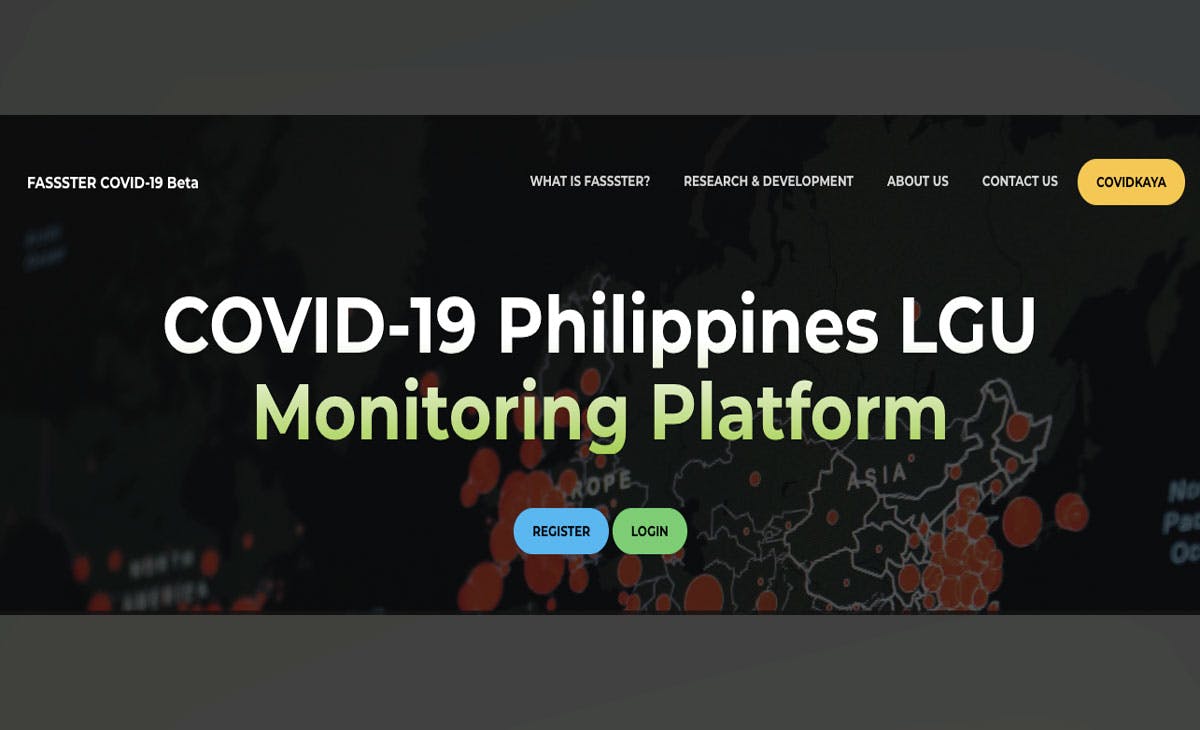
The Department of Health (DOH) has “officially adopted” the Ateneo de Manila University-led Feasibility Analysis of Syndromic Surveillance using Spatio-Temporal Epidemiological Modeler (FASSSTER) as the government’s monitoring tool for the coronavirus disease 2019 or COVID-19 pandemic, four years after it was developed for the surveillance of dengue, measles and typhoid.
In an Aug. 26 forum by the Ateneo de Manila School of Science and Engineering, Department of Science and Technology Secretary Fortunato de la Peña said FASSSTER is an example of how data science research can be used as a platform that “elevates reliable predictions to support real-time decision-making for the COVID-19 crisis.”
“While many theoretical research remain theories that can only be tested in experimental environments, FASSSTER was able to apply theoretical modeling in real life,” De la Peña said.
Ateneo de Manila University president Fr. Roberto Yap said FASSSTER aims to create a hub containing data from different sources like disease records, environment and economic as well as political parameters to provide “a rich layout of integrated information that will facilitate the understanding in the spread of diseases.”
Yap said FASSSTER also seeks to provide a user-friendly tool for monitoring the spread of a disease and aid the DOH’s surveillance efforts, as well as provide a “flexible platform that can generate projections based on a combination of selected scenarios.”
According to FASSSTER project lead Maria Regina Estuar, a professor at the Ateneo’s Department of Information Systems and Computer Science, the design of the platform was changed to reflect its turnover to the DOH, but users will still get to use their existing accounts.
FASSSTER contains 19 data modules, Estuar said. “We don’t want to have more than 19, para mag-match siya sa (so it matches) COVID-19.”
These are grouped into five: health indicators, health capacity, and social, economic and security data. These will guide national government agencies and local government units in tweaking their responses not just to the contagious disease itself but also to its impact on the livelihood and safety of people.
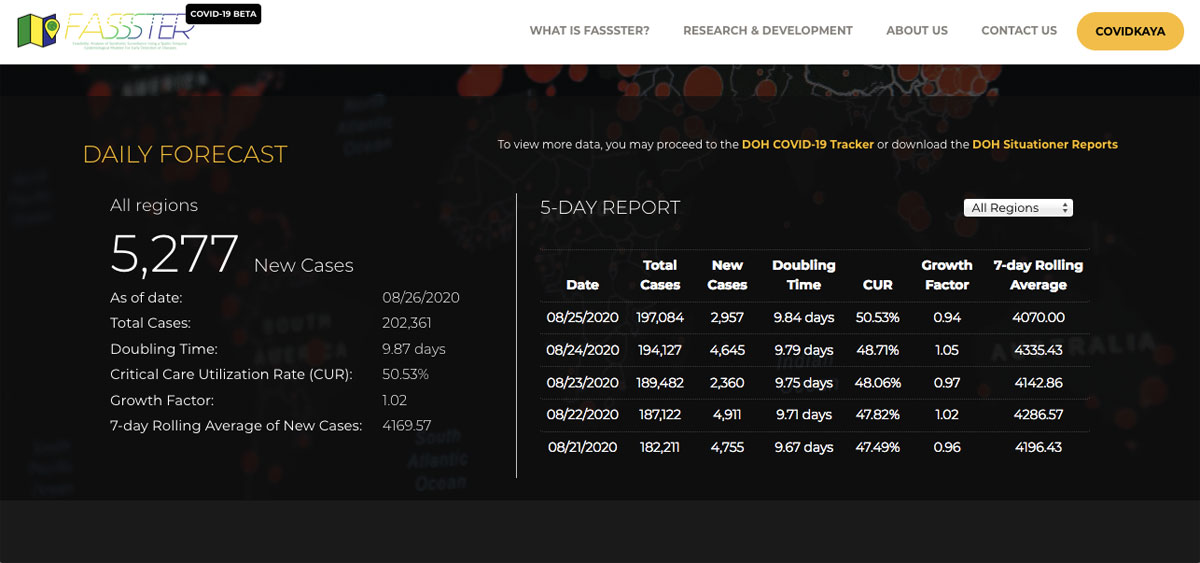
Data available include doubling time (the longer it takes for the number of total cases to double, the better), risk classification, epidemic curves, time-varying reproduction number (the number of persons who can be infected by each confirmed COVID-19 case, which ideally should be below one), and attack rates (the probability that an infection occurs among susceptible persons within a reasonable incubation period).
There is also an age-structured model that can be used to make policies based on different scenarios involving various age groups, as well as localized analysis in barangays deemed to be COVID-19 hotspots.
There is so much available data that Estuar said users should “expect some delays if it is the first time you’re logging into the new version of the platform.”
She added that researchers constantly work on time-series projections and update models every night, which are then compared against emerging real data to make short-term and longer-term projections accurate.
Besides projections and models, FASSSTER also features data on corresponding hospital equipment and testing requirements as well as isolation projections.
Yap stressed that FASSSTER and the DOH Monitoring Toolkit are “essential if our response to the coronavirus is to be evidence-based and guided by the best scientific analysis possible.”
He said FASSSTER was part of Ateneo’s efforts to achieve its “second strategic goal” in the AMDG 2030 strategic plan. This is to “broaden our influence in building the nation and Asia-Pacific region” and “influence policy and action” through social development programs, think tanks, policy centers and research units.
DOH Undersecretary Lilibeth David credited the system for informing local government units about “where they are at the epidemic stage and the socio-economic and security status of their areas,” so that they could forecast the epidemic curve and plan forward.
“In a very short duration, FASSSTER has really proved itself as a mechanism to inform the government for placing effective barriers, physical or otherwise, that protect the population against the further spread of the infection,” David said.
At the same time, David touted how FASSSTER “has informed us how effective we are in implementing minimum public health standards… in controlling the spread of the virus and securing the health of the Filipino people.”
“Within the best possible way, our country has crystallized its commitment – first, to prevent cases, and second, manage contact and cases early on. All the while ensuring that our interventions will not cause them financial hardship,” she stressed.
De la Peña expressed hope that the adoption of FASSSTER would “enjoin more researchers to work with us and encourage policy-makers to support initiatives that bring science closer to the people.”
Expressing her gratitude to Ateneo and the University of the Philippines, David said: “Partnerships like this, when cultivated well, can harness the strength of every sector to ultimately prevail in our fight against COVID-19.”


