



DepEd: Mandatory Wearing Of Face Masks Stays In Schools
The Department of Education said a face shield may be used by the students in lieu of a face mask for specific situations where removal of the face covering is needed.
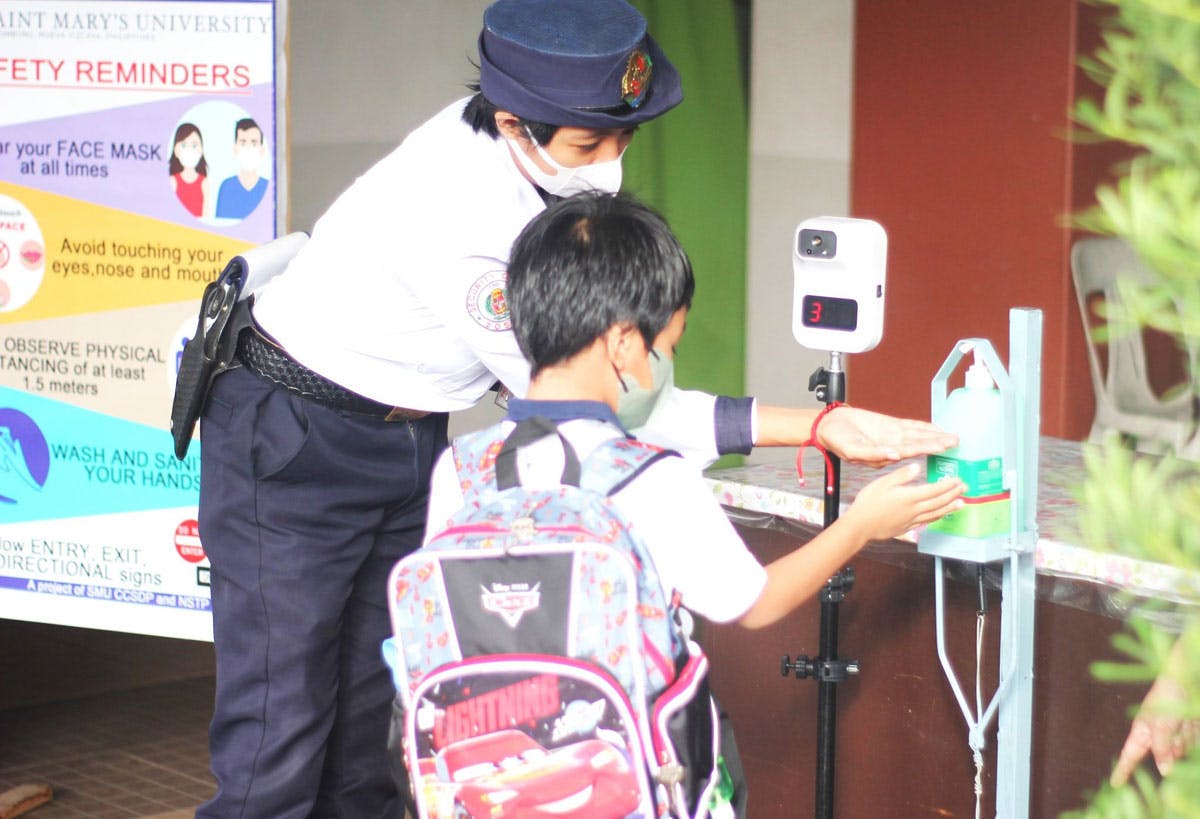
While wearing of face masks will be voluntary in open spaces and non-crowded areas with good ventilation, it will remain mandatory inside classrooms, laboratories and other school rooms, the Department of Education (DepEd) said on Thursday, Sept. 22, as it issued health policies for the conduct of face-to-face classes.
“The school shall ensure availability of face masks especially for learners who may come to school not wearing one. The school may seek the assistance of the local government as needed to ensure ample and regular supply of face masks,” read the department order signed by Vice President and Education Secretary Sara Duterte on Sept. 19.
“The school may seek the assistance of the local government as needed to ensure ample and regular supply of face masks,” it added.
It noted that health and sanitation expenses may be charged against the use of special education funds of local government units.
The DepEd said a face shield may be used in lieu of a face mask for specific situations where removal of face mask is warranted, such as activities requiring the entire face of an individual to be visible.
“During these specific activities, safe distance, adequate ventilation and proper hygiene shall be strictly ensured at all times,” it added.
President Marcos earlier issued an executive order allowing voluntary wearing of face masks in outdoor settings.
Commission on Higher Education (CHED) chairman J. Prospero De Vera III also issued a memorandum reminding colleges and universities of the latest policy on wearing of face masks.
“Pursuant to Executive Order No. 03, this is to reiterated to the higher education community that the voluntary wearing of face masks in open spaces and non-crowded outdoors areas with good ventilation is allowed, provided that not fully-vaccinated individuals, senior citizens and immunocompromised individuals are highly encouraged to wear their masks, and physical distancing will be observed at all times,” said De Vera.
“Further, face masks shall continue to be worn in indoor private or public establishments, including in public transportation by land, air or see, and in outdoor settings where physical distancing cannot be maintained,” he added.
No discrimination
Meanwhile, in its latest health and safety policy, the DepEd reiterated that it strictly implements a “no discrimination” policy among those vaccinated and unvaccinated individuals.
Unvaccinated students and personnel are allowed to attend face-to-face classes and will not be required to undergo regular COVID-19 testing.
However, the agency stressed that DepEd offices and schools shall not be held liable if a personnel or student tests positive for the viral illness.
“DepEd continues to recognize vaccination as among the most effective strategies for the prevention of COVID-19 deaths,” read the order.
“Schools shall coordinate with health authorities from the local government to encourage and educate stakeholders on the benefits of COVID-19 vaccination especially among the families of unvaccinated teaching and non-teaching personnel and learners and implement mobile vaccinations for those who sign a written consent to be vaccinated,” it added.
It also reminded regional offices to ensure the regular reporting of vaccination status of personnel.
Ventilation
The policy also contained other health protocols to be implement in schools, including regular handwashing, sanitation and physical distancing “whenever possible.”
The DepEd also reminded schools to ensure proper ventilation in classrooms and other areas as a way to prevent outbreaks.
“Adequate ventilation may be achieved through natural ventilation such as opening of windows and doors, while ensuring that nearby spaces of open windows are free from toxic gases and pollutants,” said the agency, which also recommended using exhaust fans or placing fans near windows.
“Proper ventilation in communal restrooms must not be overlooked. If installed. exhaust fans in these areas must be operational and at full capacity whenever the space is occupied. All users must remember to close the lids of toilet bowls before flushing. The acts of flushing contribute to dispersion of contaminants inside the restrooms,” it added.
The Aral Pilipinas coalition, composed of various groups representing different education stakeholders, earlier urged the DepEd to issue clear ventilation guidelines to minimize risk during the conduct of face-to-face classes.
For non-air-conditioned classrooms and spaces, it recommended opening windows, doors and other openings to increase outdoor airflow when weather conditions allow.
Placing fans facing out the windows and doors, it said, can help draw fresh air into the room through other open windows and doors.
Aral Pilipinas also recommended equipping teachers with microphones to reduce the degree of vocalization and reduce aerosol transmission.
Meanwhile, for air-conditioned classrooms and spaces, it pushed for the use of filtration devices to improve air quality.
“If raw materials are available, creating Corsi-Rosenthal boxes with MERV 13 filters for classrooms is possible,” it added, referring to the do-it-yourself air purifier that can reduce viral particles in the air.
“Keep heating, ventilation and air conditioning systems in good working condition. Install exhaust fans in the room to improve ventilation,” added the coalition.
Be patient
The Department of Health (DOH) has appealed to parents of children below five years old to be more patient in waiting for the approval of COVID-19 jabs for the age group while it is still undergoing studies.
“Up until now, we are still studying this further. Not all countries are implementing COVID-19 vaccination for children less than five years old because they also know that more studies are necessary. We hope that our parents will be more patient on this matter,” DOH officer-in-charge Maria Rosario Vergeire said.
Vergeire said parents should not be much concerned as the age group 0-4 years old is not among those considered highly vulnerable to COVID-19.
“The less than 5 years old are not part of those contributing too much in the number of cases in the country,” the health official added.
She then urged parents to make sure that their children are protected against COVID-19 by adhering to safety proto-cols. “Let us protect our children, especially those that we cannot vaccinate at this time,” Vergeire said.
The United States and Canada are among the few countries that have approved COVID jabs for children as young as six months using SARS-CoV-2 vaccines from Pfizer and Moderna.
In the Philippines, the youngest age group allowed for COVID-19 vaccines are those between five and 11 years old, who are recommended two primary doses.
Data from the DOH showed that as of Sept. 18, nearly five million children aged five to 11 are now fully vaccinated against COVID-19. – With Rhodina Villanueva


