



DA Chief: Price Of Rice Can Be Lowered To P27 Not P20 Per Kilo, But…
Agriculture Secretary William Dar said there are ways to bring down the price of rice per kilo but these would entail big budget from the government.
Is the campaign promise of presumptive president Ferdinand “Bongbong” Marcos Jr. to bring down the price of rice to P20 per kilogram possible?
According to Agriculture Secretary William Dar, there is a way to lower the price of local rice, but it could only be P27 per kilo.
In an interview with “One Balita Pilipinas” on One PH on Wednesday, May 18, Dar wondered who advised Marcos that the price of rice could go as low as P20 per kilo.
“I want to understand whoever broached the idea to presumptive president (Marcos), how they could make the (price of rice) P20 per kilo,” Dar said in Filipino.
The agriculture chief explained that the current farmgate price of palay is already at P19 per kilo, and several farmer groups have been lobbying to raise it.
He said one way to lower the price of rice is to increase the National Food Authority’s (NFA) P7-billion budget to P30 billion annually so the buffer stock could be raised from seven days to one month.
“‘Yung mandato po kasi ng NFA under [Rice Tariffication Law] ay pang-buffer stocking. At ‘yun ay meron silang buffer stocking good for seven days only. ‘Yung P7 billion, sabihin mo na lang one billion a day ang buffer stocking. Now ang panukala ko dun ay through executive decision ay dagdagan natin ang budget ng NFA para gawin natin instead of seven days buffer stock o stockpiling, ay gawin nating good for 30 days ‘yun (The mandate of the NFA under the [Rice Tariffication Law] is for buffer stocking, and the buffer stocking is good for seven days only. The P7 billion, let’s say it’s for buffer stocking amounting to P1 billion a day. Now my proposal is that through executive decision, let’s raise the budget of the NFA so that instead of seven days of buffer stocking, we’ll make it good for 30 days),” Dar said.
To attain this, Dar noted, an additional budget of P23 billion is needed.
“Alam naman ninyo ‘yung bigas na iniimbak ay you have to sell that in the market, so nag-ro-roll over ‘yan at ‘yung dating presyo ng NFA rice na nandun sa merkado ay pwede P27 kada kilo (You know, the rice that has been stored must be sold in the market, so that’s being rolled over, and the previous price of the NFA rice in the market can be P27 per kilo),” Dar said.
To ensure the stability of rice prices, the NFA buys palay from individual farmers or farmer organizations at the government support price especially during emergency situations, such as when man-made calamities hit.
During a “Laging Handa” public briefing, Dar said the price of rice could only be lowered if production cost decreases and the top 20 rice-producing provinces are given concessional loans.
Dar also stressed that the P20 per kilo of rice could only be offered to the poorest of the poor or the beneficiaries of the Pantawid Pamilyang Pilipino Program or 4Ps.
“I did not say P20, P27 ng NFA rice,” Dar clarified during his interview with One Balita Pilipinas.
He said the price of palay could be lowered in the future through various programs so that the price of rice would also go down.
For Albay 2nd District Rep. Joey Salceda, the government needs to spend P150 billion annually to make the campaign promise of Marcos a reality.
“Kailangan gastusan ‘yan ng P150 billion in terms of budget,” Salceda, who is an economist, told “One Balita Pilipinas” on Friday, May 13.
“Pero kung ibababa mo ‘yan at di mo kailangan patayin ang magsasaka, kailangan bilhin mo ‘yan ng P30 tapos ibenta mo na P20. Gobyerno na ang bibili ng bigas at saka dahil 15 percent ng bigas ay inaangkat sa Vietnam, huwag mo na patungan ng 45 percent tariff (But if you bring down the price [of rice] without the need to kill the farmers, you have to buy it at P30 and then sell it for P20. The government will buy the rice, and since 15 percent of it is being imported from Vietnam, then the 45 percent tariff has should not be imposed as well),” Salceda said.
Salceda, however, pointed out that this would result in a “big loss” for the government since it has to forgo P15 billion from tariff and shell out P150 billion for subsidy or around P165 billion in total.
“Malaking kawalan ‘yan sa pondo at kung may P15 billion let’s say from tariff at P150 billion price subsidy so meron kang P165 billion, pero ang budget ng [Department of Agriculture] ay P94.6 billion lang for 2022,” he underscored.
It was in April when Marcos made the promise of working to bring down the price of rice to P30 per kilo by recommending a price cap on the staple. He also pushed for the amendment of the Rice Tariffication Law, which allows the unlimited importation of rice, and puts a minimum of 35 percent tariff on rice imports.
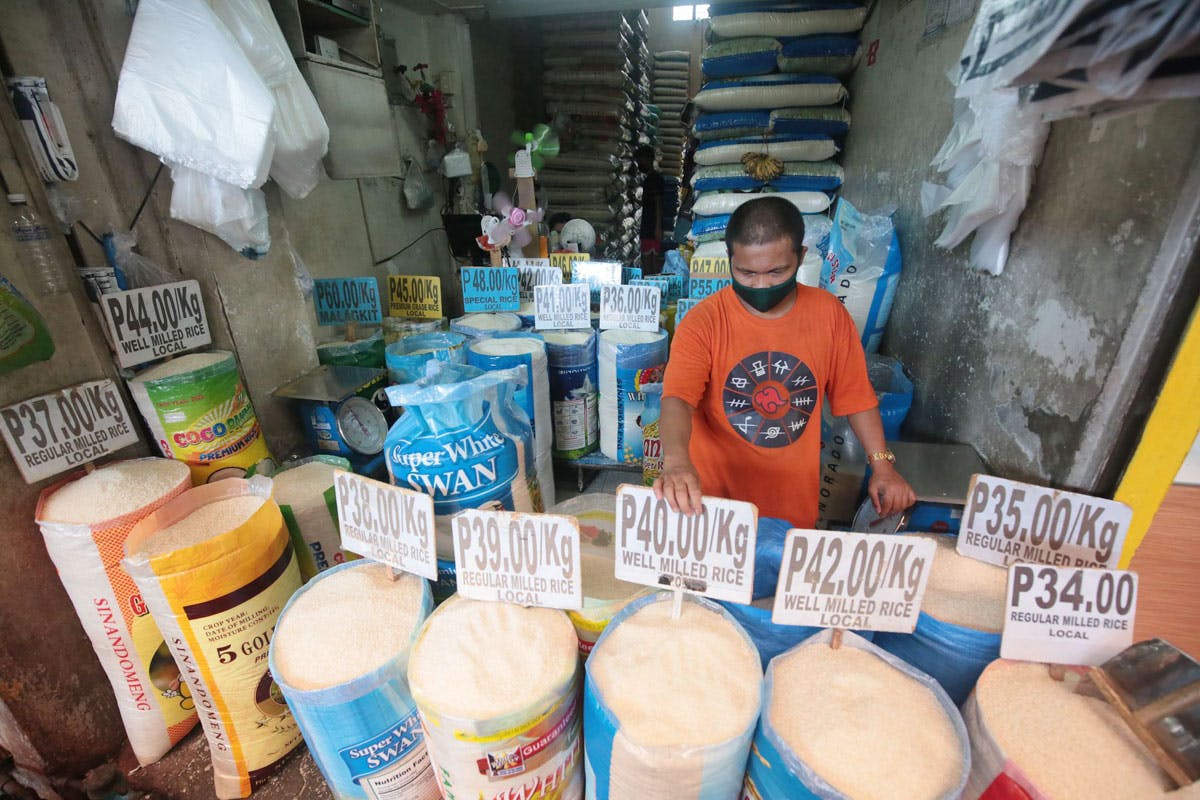
Currently, rice prices in the market range from P38 to P50 per kilo for local commercial rice, and P37 to P52 for imported commercial rice.
Socioeconomic Planning Secretary Karl Kendrick Chua, in a press conference on May 12, also said while Marcos’ campaign promise is possible, it would be a “bad idea” if it would be subsidized without conditions.
“If we are going to use taxpayers’ money solely to subsidize without conditions and without any productivity measures, then that’s a bad idea,” he said.
Salceda noted that based on analysis, the plan to offer rice at P20 per kilo would be hard to implement as the government would spend a lot for it.
“Sa simpleng computation, mas gagastos ng malaki para maipatupad ‘yung patakaran na P20 kada kilo at the same time baka papatayin mo ‘yung 3.4 million rice farmers (In simple computation, you would have to spend more to implement this P20 per kilo [of rice] scheme, at the same time you might have to kill our 3.4 million rice farmers),” he said.


